REVIEW · FREMANTLE
Fremantle – Convicts, Culture & Street Art
Book on Viator →Operated by Two Feet and a Heartbeat Perth · Bookable on Viator
Convicts, tunnels, and street art in one short walk. I love how this tour strings prison-era stories together with Indigenous history, and I love the payoff of seeing key sites like the Whalers Tunnel and the Round House without feeling rushed. The main trade-off: it’s only about 2 hours, so you’ll get “watch, listen, learn” rather than slow museum-style time at each stop.
What you’re really buying is a guided orientation of central Fremantle, led by a local host. This is a small-group format (up to 12 people), and the walk is paced for moderate fitness, starting at 10:00 am from the Fremantle Visitor Centre on High St.
You’ll also get coffee and/or tea, which is a nice touch when you’re doing multiple short stops in a row. You’ll want to bring your own water and sun protection since bottled water isn’t included, and the experience is weather-dependent.
In This Review
- Key highlights you’ll feel on the ground
- Meeting at the Fremantle Visitor Centre and getting your bearings fast
- Town Hall to Walyalup Koort: where Fremantle’s old and new talk to each other
- The pedestrian mall and trade streets: street art as a living history lesson
- Fremantle Ports and C.Y. O’Connor: how a port shaped the city
- Whalers Tunnel: the limestone corridor that moved whale products
- The Fremantle Round House: oldest building, first prison, heavy atmosphere
- Bather’s Beach and Esplanade Park: settlers landing and Aboriginal history in the same breath
- South Terrace and the Cappuccino Strip finish: you leave with a plan for the next hour
- Price and value: what $46.62 buys you in real terms
- Who should book this Fremantle walk?
- Should you book this Fremantle Convicts, Culture & Street Art tour?
- FAQ
- FAQ
- How long is the Fremantle Convicts, Culture & Street Art tour?
- What is the starting location?
- What time does the tour start?
- Where does the tour finish?
- What does the tour cost?
- What’s included in the price?
- Is food included?
- Is this a mobile ticket?
- How many people are in the group?
- What happens if the weather is bad?
- Are there any conditions for booking or participation?
Key highlights you’ll feel on the ground
- A convict-and-culture story line tied to specific places, not just general facts
- Whalers Tunnel: walk through limestone cut to move whale products inland
- The Round House: Fremantle’s oldest building and its first prison
- Ports history with C.Y. O’Connor: how the late-1800s/early-1900s port came together
- Street art + civic revival around Walyalup Koort and the Cappuccino Strip
- Coffee and/or tea included to keep energy up during the 2-hour loop
Meeting at the Fremantle Visitor Centre and getting your bearings fast
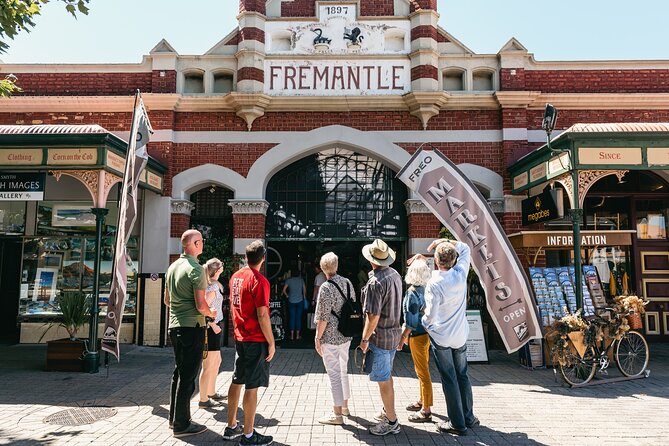
Most walks start with “Here’s where we’ll go.” This one starts with context, right from the Fremantle Visitor Centre at 155 High St. If this is your first time in town, that’s a big plus. Fremantle can feel like a mix of lanes, heritage buildings, and modern murals, and a good first pass helps you read the place later on your own.
The tour is scheduled to run from 10:00 am for about 2 hours. It’s also set up with a small group size (max 12), which matters when you want questions answered without shouting over a crowd.
And yes, you’ll have a mobile ticket, so you don’t need to hunt for paper. Just make sure your phone battery is healthy, because you’ll be out walking.
You can also read our reviews of more tours and experiences in Fremantle.
Town Hall to Walyalup Koort: where Fremantle’s old and new talk to each other
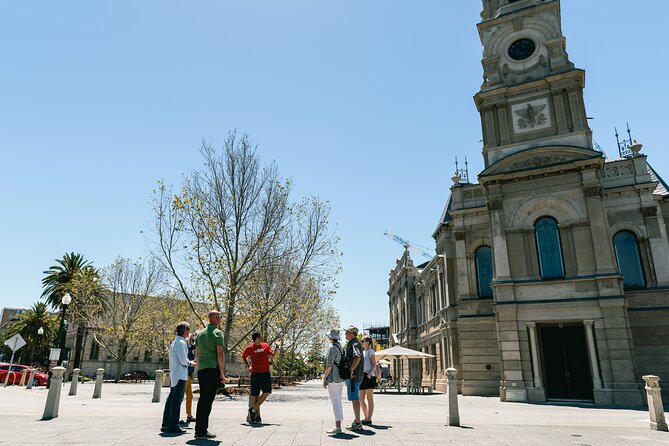
You kick things off around Fremantle Town Hall. It’s a handy starting point because it puts you in the right mental gear: civic Fremantle. From there, you head toward Walyalup Koort, the area described as Fremantle’s renewed civic heart.
A big part of the experience here is how the walk shifts from colonial-era framing into what the town has become. That change is the point. Fremantle isn’t frozen in time, and the street-art layers help you see how modern identity sits on top of older stories.
You’ll also spend a moment at FOMO Freo, a hub with art, architecture, culture, retail, and dining, anchored in Walyalup Koort. Even if you’re not planning to shop or eat during the tour, it’s useful as a landmark. It helps you connect the “heritage” you’re hearing about with the places people actually use now.
Potential drawback: the “short stop” format means some areas are more of a look-and-learn pass than a hang-out. If you love lingering over details, you might want to come back later and do a second self-guided wander.
The pedestrian mall and trade streets: street art as a living history lesson
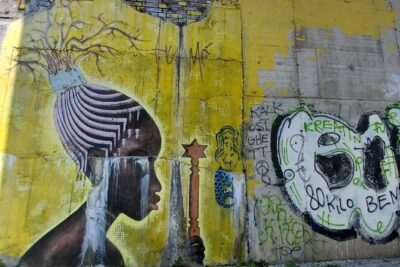
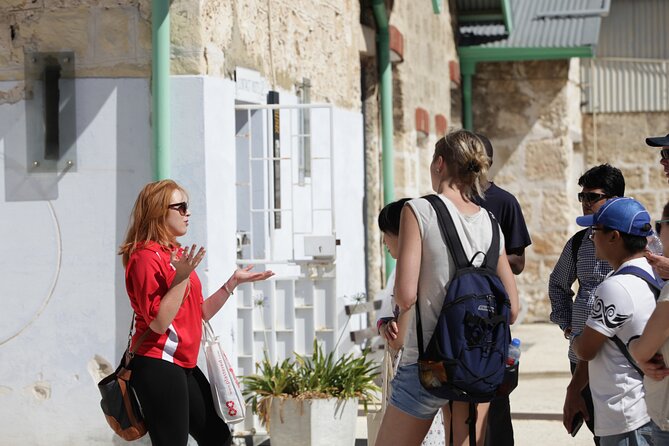
The walk includes a pedestrianised mall area between Fremantle’s Cappuccino Strip and Walyalup Koort. This is where the tour earns its street-art focus. You’re not just seeing art; you’re seeing how it’s used as commentary, decoration, and cultural signaling in a space that people actually walk through daily.
Then you head down one of Fremantle’s key streets for trade in the heart of historic Fremantle. That matters because it ties together two themes: commerce and punishment. Fremantle’s convict past and its economic growth weren’t separate tracks. They ran side by side, and the tour makes that connection in small, digestible moments.
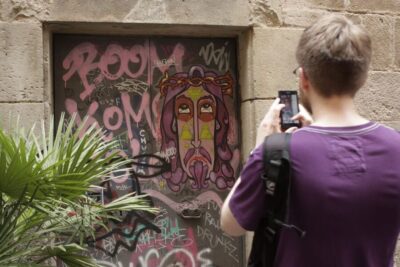
Tip for you: don’t rush your photos. Stand for ten extra seconds when the guide points out a landmark or an art feature, because the story attached to it is usually the “why,” not just the “what.”
Fremantle Ports and C.Y. O’Connor: how a port shaped the city

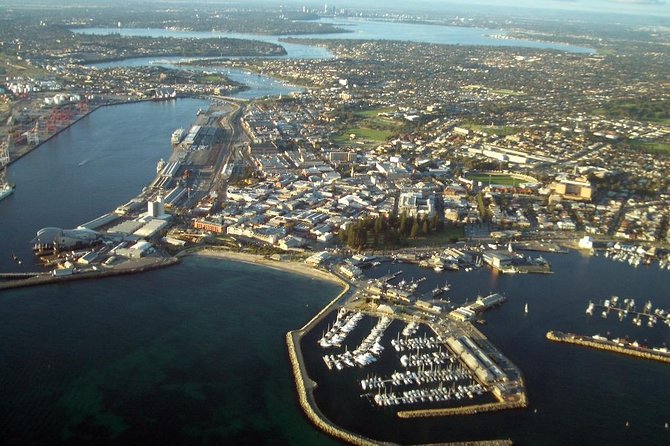
Next up is Fremantle Ports, tied to the port construction created in the late 1800s/early 1900s. This part is more than ship trivia. You learn about the construction and the man behind it—C.Y. O’Connor—who is highlighted as key to making it possible.
Why this is worth your time: ports are the engine of a coastal city. They determine where people work, what gets imported, what industries rise, and which buildings and tunnels get built. When you understand that, the convict and industrial history you’ve been hearing starts to feel more connected.
You’ll have around ten minutes here. That’s not long, but it’s long enough to walk away with a mental map of how Fremantle’s physical layout grew around its maritime role.
One practical note: ports areas can change in sun exposure depending on the day. If it’s bright, you’ll be glad you brought a hat and sunglasses.
Whalers Tunnel: the limestone corridor that moved whale products
The Whalers Tunnel is one of the most memorable stops because it’s physical history. This tunnel was created to transport whale products from the waters edge to High Street, cut directly into the limestone cliff.
You’ll walk through it as part of the route, and it’s the kind of place where you instantly get how labor and logistics worked. Big stories are often told with dates and names; this one is told with stone. You’re moving through a space built for work, which makes the past feel tangible.
At about five minutes, you won’t be stuck. But even in that short time, the tunnel gives you a strong “this is how things actually moved” feeling. It’s also a great contrast to the open-air street art you saw earlier.
Consideration: tunnels can be cooler than the street, and lighting varies. If you’re someone who cares about photos, keep your camera settings in mind and don’t expect the same brightness you get outside.
The Fremantle Round House: oldest building, first prison, heavy atmosphere
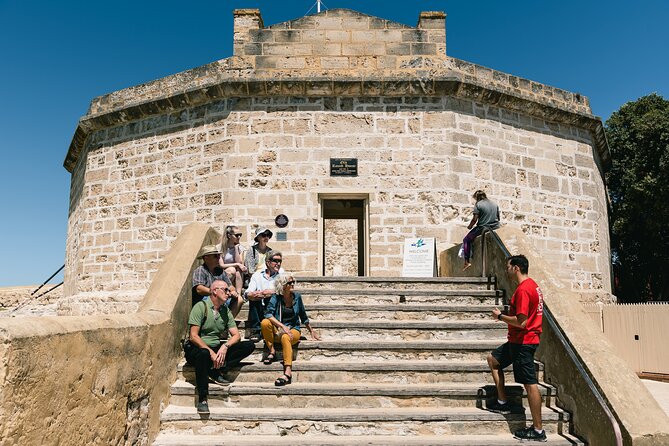
Then you reach The Fremantle Round House, described as the oldest building in the city and its first prison. This is the convict anchor of the walk, and it’s also where the tour’s themed storytelling really sharpens.
A round building changes the vibe. You can’t help but notice how different it feels from street-level commerce. It reads like a deliberate structure meant to control people, not just house them.
You’ll only spend a few minutes here, but the stop is designed to give you a grounded understanding of what “first prison” means in this setting. The tour’s broader promise includes daring prisoner escapes, and the Round House helps put that kind of story in context.
Tip: if you’re the type who likes to keep a timeline in your head, this is a good moment to mentally connect the convict era to the port and the labor economy you just heard about.
Bather’s Beach and Esplanade Park: settlers landing and Aboriginal history in the same breath
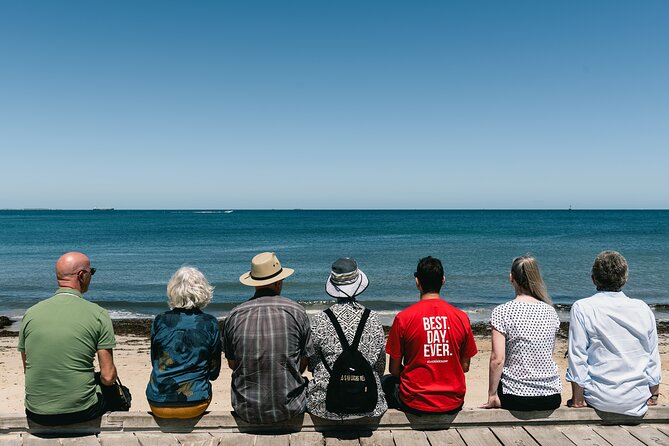
After the heavier prison stop, the tour shifts toward the shoreline and land story. At Bather’s Beach, you see where the first settlers to Western Australia came ashore. It’s also noted that you might even climb on top of what remains of the original timber-piled jetty.
That “maybe you can” detail matters. It means you’re not committing to a single kind of footing. Bring shoes you’re comfortable walking in, and don’t force it if the surface looks sketchy.
Then you head to Esplanade Park. This is where the tour folds in reclamation of land plus Aboriginal history of the area. If you’re trying to understand Fremantle beyond one era, this stop helps a lot. The coastline and the way land was shaped are part of the story of people living here, not just an environmental footnote.
Timing is still tight here (around ten minutes), so you won’t get long-form interpretation. Still, the stop is meaningful because it broadens the narrative beyond convict walls and maritime industry into the deeper geography of the region.
South Terrace and the Cappuccino Strip finish: you leave with a plan for the next hour
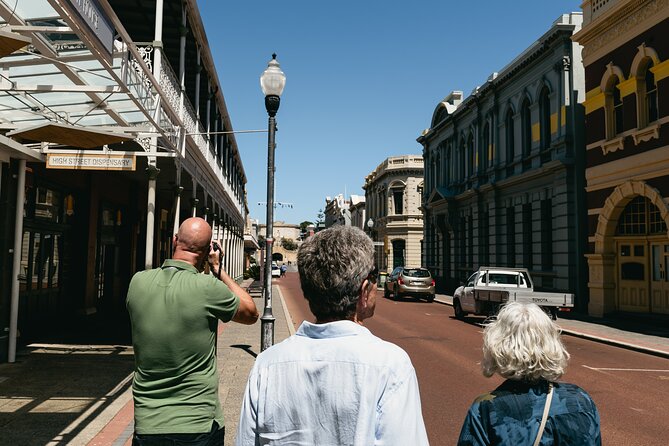
You finish on South Terrace, on the famous Cappuccino Strip. This is a smart way to end. By the time you reach it, you’ve got enough context to make the area feel like more than just cafes and foot traffic.
Also, if you want to keep the day moving, this is where you can do it naturally. The tour includes coffee and/or tea, but finishing on South Terrace gives you options for a real meal afterward.
The vibe is relaxed at the end, and that’s helpful. Two hours can feel “busy-busy” if you’re constantly craning your neck and taking photos. Ending with a familiar leisure strip helps you decompress.
Price and value: what $46.62 buys you in real terms
At $46.62 per person, the price sounds modest, and the value mostly comes from what’s included. You get a professional local host, orientation of central Fremantle, local history and fun stories, plus coffee and/or tea.
Also, the stops themselves are free to access at each point listed. That matters because you’re not stacking entry fees on top of the ticket. You’re paying for guided context and efficient time on foot across key sites.
Is it worth it for everyone? It’s a great fit if you want a guided “first look” and you like story-driven walks that connect places. If you prefer long museum time or you only want one theme (only street art, only prisons, only ports), you might feel limited by the short duration.
Group size helps here too. With up to 12 people, you’re more likely to hear details clearly and ask quick questions.
Who should book this Fremantle walk?
Book it if:
- you want a short, guided way to understand Fremantle’s convict-era sites plus Indigenous history
- you like street art with context, not just photo spots
- you’re happy with a moderate walking pace and a couple of standing moments
Skip it or consider something else if:
- you need extended time at major sites
- you dislike tunnels, enclosed spaces, or you’re easily uncomfortable in such settings
- you want a food-focused tour; while there are dining areas nearby, the tour itself doesn’t include meals beyond coffee/tea
Should you book this Fremantle Convicts, Culture & Street Art tour?
If you’re in Fremantle for a short stay, I think it’s a strong choice. You get a guided thread that connects prisons, ports, shoreline, and street art in just about 2 hours—enough time to get your bearings and enough variety to keep it interesting.
My only caution is the format. It’s quick stops, so come ready to listen, look, and move. If that sounds like your style, this is the kind of walk that makes you notice the city long after you’ve left.
FAQ
FAQ
How long is the Fremantle Convicts, Culture & Street Art tour?
It runs for about 2 hours.
What is the starting location?
The tour starts at Fremantle Visitor Centre, 155 High St, Fremantle WA 6160, Australia.
What time does the tour start?
The start time is 10:00 am.
Where does the tour finish?
It finishes in Fremantle, Australia.
What does the tour cost?
The price is $46.62 per person.
What’s included in the price?
It includes a professional local host, orientation of central Fremantle, local history and fun stories, and coffee and/or tea.
Is food included?
No. Bottled water and food/drinks are not included unless specified.
Is this a mobile ticket?
Yes, it’s a mobile ticket.
How many people are in the group?
The tour has a maximum of 12 travelers.
What happens if the weather is bad?
The experience requires good weather. If it’s canceled due to poor weather, you’ll be offered a different date or a full refund.
Are there any conditions for booking or participation?
You should have a moderate physical fitness level. Service animals are allowed, and the tour is near public transportation.