REVIEW · PISA
Pisa Street Art Self-Guided Bike Tour
Book on Viator →Operated by Smile & Ride · Bookable on Viator
One mural sets the tone in Pisa. This self-guided e-bike route pairs street art with big-city sights at a comfy pace.
You start with Keith Haring’s Tuttomondo and roll toward the Leaning Tower area, with an app doing the heavy lifting.
What I like most: the ride is low-stress, and the bikes feel easy from the first minute. I also love how the route nudges you past spots you’d skip if you only walked.
One thing to plan for: you’ll rely on your phone/app, so a dead battery can slow you down. Also, a helmet costs extra if you want one.
In This Review
- Key things to know before you pedal
- Why Pisa street art on an e-bike makes sense
- Meeting at Smile & Ride: what you need for a smooth start
- Keith Haring at Tuttomondo: the color kickoff
- Eduardo Kobra’s Galileo Galilei: art that talks to Pisa
- Following the app route toward the Leaning Tower
- Price and practical gotchas for your 3-hour ride
- Should you book this Pisa street art e-bike tour?
- FAQ
- How long is the Pisa Street Art self-guided bike tour?
- Where does the tour start and end?
- Is this experience guided by a person?
- What’s included in the price?
- Do I need to bring a helmet?
- Which street art stops are part of the route?
- Is the tour offered in English?
- Can I cancel for free?
Key things to know before you pedal
- E-bike comfort first: You get the bike, a lock, and a phone holder, so you can focus on the route.
- Two major murals are the anchors: Keith Haring’s Tuttomondo and Eduardo Kobra’s Galileo Galilei are your key art stops.
- Free admission for the murals shown on the route: Both highlighted stops are free to visit.
- It’s private, but self-guided: Only your group rides, and you’re responsible for navigation using the app.
- The price is strong value for 3 hours: At about $23.37 per person, it’s a cost-effective way to cover more Pisa per day.
Why Pisa street art on an e-bike makes sense
Pisa is one of those places where you can cover a lot on foot, but distances still add up fast. An e-bike gives you that happy middle ground: you move quickly, yet you’re not racing like you would on a scooter.
This is also a smart way to see Pisa’s public art without needing a deep art lecture. The route centers on two famous mural artists, so you get instant context just by following the trail. Then you roll toward the Leaning Tower area, where the city’s medieval postcard fame meets modern street creativity.
The timing works too. You’re looking at about 3 hours on the bike, which is long enough to feel like you had a real outing, not a quick hop. And because it’s a private activity, your group rides together without blending into a larger crowd.
Finally, it’s surprisingly practical for a self-guided format. You’re not stuck staring at your map. The setup includes an app with an itinerary, and you can keep your phone mounted while you ride. If you like independence but still want structure, this checks that box.
Meeting at Smile & Ride: what you need for a smooth start
Your starting point is Smile & Ride at Piazza della Stazione, 7, Pisa. It’s a straightforward place to find, and the area is near public transportation, so you’re not locked into a specific plan.
You’ll pick up the ride basics for the experience. Included are use of bicycle, a bike lock, and a phone holder. That last item matters more than you’d think, because your route guidance is on your phone and you’ll want it where you can glance quickly and safely.
You get a mobile ticket, and the experience is offered in English. That’s a big plus if your Italian is more like a few polite phrases than full conversation. Also, confirmation is sent at booking time, so you’re not left guessing about whether you’re on the list.
Two small cost add-ons are worth knowing. A helmet is not included, and it runs €3.00 per person if you want one. Snacks and food and beverages are also not included, so plan a drink break or pick something up nearby before you set off.
And here’s the pro tip I’d take from the experience style: charge your phone fully before you go. One rider even suggested bringing battery backup, because the app needs power while you’re riding. It’s easy to underestimate screen time when you’re stopping at art points and following turn-by-turn guidance.
Keith Haring at Tuttomondo: the color kickoff
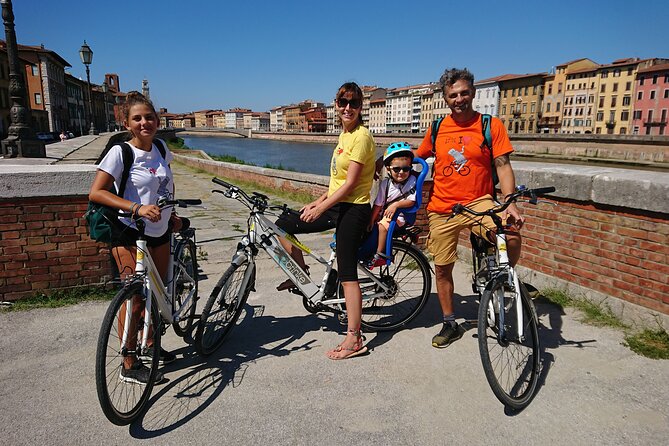
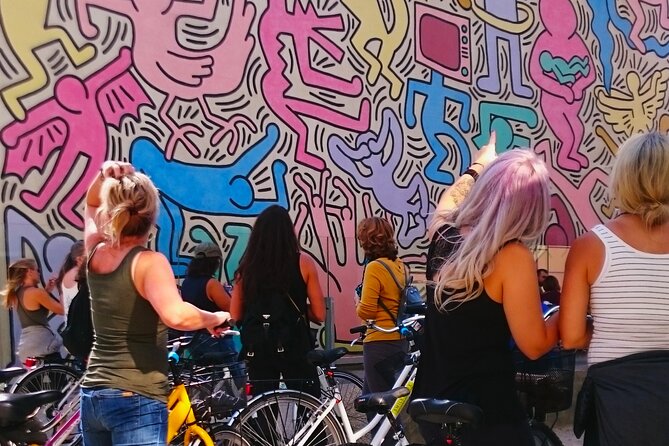
Your first big mural stop is Murale Tuttomondo di Keith Haring. The work is called Tuttomondo, created in 1989, and it’s described as one of Keith Haring’s last public murals before his death. It’s also one of the few outdoor public works made for permanent display.
This is a great place to start because it’s not intimidating. Even if you know little about Haring, you get the message fast: bold lines, playful figures, and that unmistakable street-energy that makes people stop and look. It’s the kind of art that makes you want to take a few photos, but it also works as a warm-up for the ride.
The visit itself is quick. The stop is listed as around 5 minutes, and admission is free for this mural. That timing is useful on a self-guided bike plan: you’re not spending half your ride parked somewhere unless you want to.
Practical note: take a second to orient yourself here. Once you’ve seen Tuttomondo, you’ll be in the mindset of following a route that connects public art to major Pisa sights. It’s also the right moment to check your phone mount and audio/route settings (if your version includes them), before you start moving again.
If you’re the type who likes meaning with your fun, this start gives you a clear thread. You’re not just biking randomly; you’re stepping into Pisa through street art first, then letting that lead you into the city’s bigger icons.
Eduardo Kobra’s Galileo Galilei: art that talks to Pisa
The next mural stop is Galileo Galilei through the eyes of Kobra. This one is by Brazilian street artist Eduardo Kobra, and it’s framed as more than just a mural. The idea is that the artwork reimagines the bond between Pisa and one of its most famous sons.
Visually, it’s described as an explosion of color. It transforms the facade of a modern building into something like a time portal, where science and contemporary street art meet. Even if you don’t read the details on your first pass, the scale and color force you to slow down.
Like the first stop, this one is also quick—around 5 minutes—with free admission. That quick stop length is ideal for a bike tour. You get the impact without losing too much ride momentum. And because it’s self-guided, you can decide on the spot if you want extra minutes for photos or a closer look.
This mural also adds a useful angle to your day. Pisa often gets reduced to one famous monument. Here, the route reminds you that the city’s identity goes beyond the postcard. It’s a city that produced thinkers, and it still embraces creative modern expression in public spaces.
If you’re riding with kids or friends who get bored by long sightseers’ stops, this pairing can work. Two mural stops give you variety—big visuals, short visits, and then back on the bike.
Following the app route toward the Leaning Tower
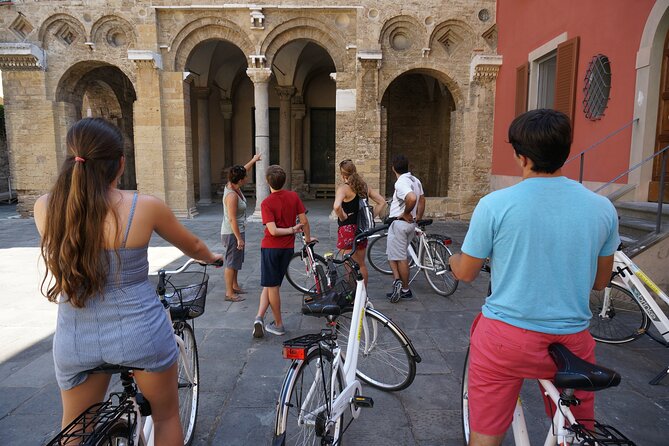
The route is designed to connect the murals with the Leaning Tower area. Your navigational tool is the app, which provides the itinerary and information as you ride. Because it’s self-guided, you’re not waiting on a group or negotiating a meeting time at each stop.
One of the most praised aspects is that the route is easy to follow. Several people highlighted that the map and instructions help you find the way, including through quieter streets and bike-friendly lanes. That’s a key advantage in a city like Pisa, where the best views aren’t always on the loudest main roads.
Another real-world tip: keep your phone charged. If you ride for around 3 hours with stops, the screen stays on, the app works, and you may also use audio guidance if your setup includes it. A fully charged phone helps you avoid the most common self-guided hassle: losing your bearings because the battery drops below your comfort level.
Pacing matters too. This tour doesn’t feel like a nonstop sprint. It’s more like a sequence of short moments—look at the art, move on, get guided information, repeat. That style makes it easier to enjoy the ride instead of just grinding through distance.
Also, you’ll want to be comfortable using an e-bike. Included use of the bicycle means you’re expected to ride it independently. If you’ve never used one before, take a minute at the start to get the feel of acceleration and braking so you’re relaxed when traffic appears.
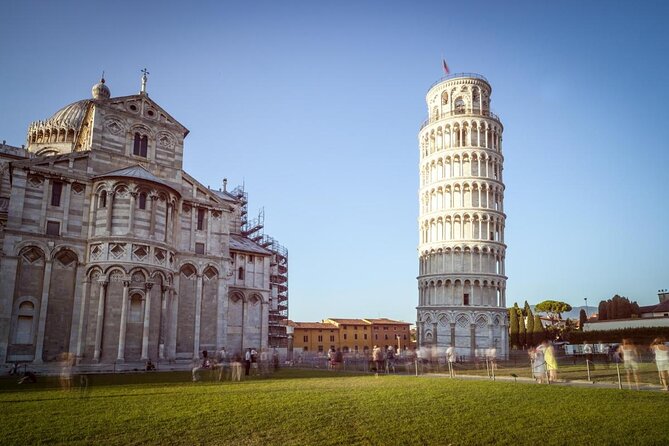
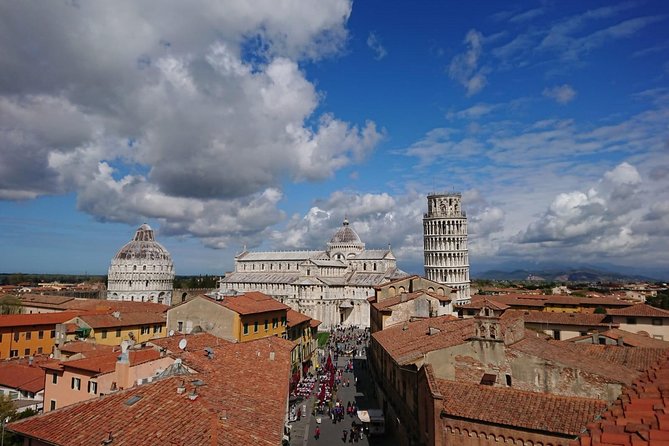
By the time you reach the Leaning Tower area, your eyes will already be trained. You’ve been moving through street art and local landmarks, so the big monument won’t feel like the only point of Pisa. It becomes a final chapter in a story that started with modern public art.
Price and practical gotchas for your 3-hour ride
Let’s talk value. At $23.37 per person for about 3 hours, this is priced like a bargain compared to the cost of a traditional guided day. You’re paying for bike access, a route app, and the freedom to explore at your own pace.
What makes it even better is that the main art stops shown on the route are free. You’re not buying separate entry tickets just to enjoy the highlights. And the gear basics—bike lock, phone holder, and the e-bike itself—are included, so you’re not hit with a surprise rental fee stack.
What can add cost is optional. A helmet is €3.00 per person if you want one. And if you decide you want a guide, a tour guide is listed as €180.00 per booking. That guide fee is separate from the base experience cost, so think of this as self-guided by default, with help available if you choose it.
The biggest practical gotcha is the phone. Because your navigation depends on the app, a dead battery can turn a smooth ride into a guessing game. Charge before you go, and consider bringing a battery backup if you’re the type who forgets to top up.
Weather is another consideration. One rider reported rain mid-ride and said the team provided ponchos around Santa Caterina. You can’t count on that every day, but it’s reassuring to know the team can react when conditions change.
If you want a low-effort sightseeing win in Pisa—especially if your schedule is tight—this can be an excellent use of time. It’s structured enough to guide you, but flexible enough that you can slow down for photos or take in an extra scene when it grabs your attention.
Should you book this Pisa street art e-bike tour?
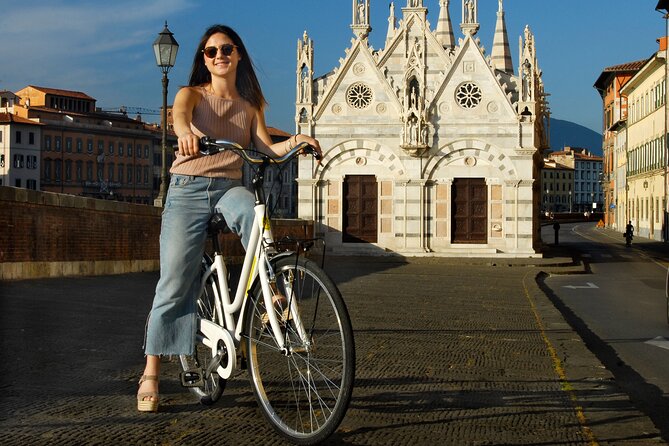
Book it if you want maximum Pisa per hour without the stress of constant walking. It’s a great match for people who like independence, enjoy street art, and want the Leaning Tower experience without treating it like a one-stop checklist.
Don’t book it if you hate relying on your phone for navigation. This is self-guided, so your success depends on using the app and keeping your device charged. Also, if you want a deep, guided explanation of art and architecture from start to finish, this experience doesn’t include a guide by default.
If you’re somewhere in the middle—curious, time-aware, and happy to ride at your own rhythm—this is a strong pick.
FAQ
How long is the Pisa Street Art self-guided bike tour?
It lasts about 3 hours.
Where does the tour start and end?
It starts at Smile & Ride, Piazza della Stazione, 7, 56121 Pisa PI, Italy and ends back at the same meeting point.
Is this experience guided by a person?
No. It is self-guided. A tour guide is listed as not included, with a separate cost of €180.00 per booking.
What’s included in the price?
Included are use of the bicycle, a bike lock, a phone holder, and an app with the itinerary (plus a mobile ticket).
Do I need to bring a helmet?
A helmet is not included. If you want one, it costs €3.00 per person.
Which street art stops are part of the route?
The route highlights Keith Haring’s Murale Tuttomondo di Keith Haring and Eduardo Kobra’s Galileo Galilei through the eyes of Kobra.
Is the tour offered in English?
Yes, it is offered in English.
Can I cancel for free?
Yes. Free cancellation is available up to 24 hours in advance for a full refund.